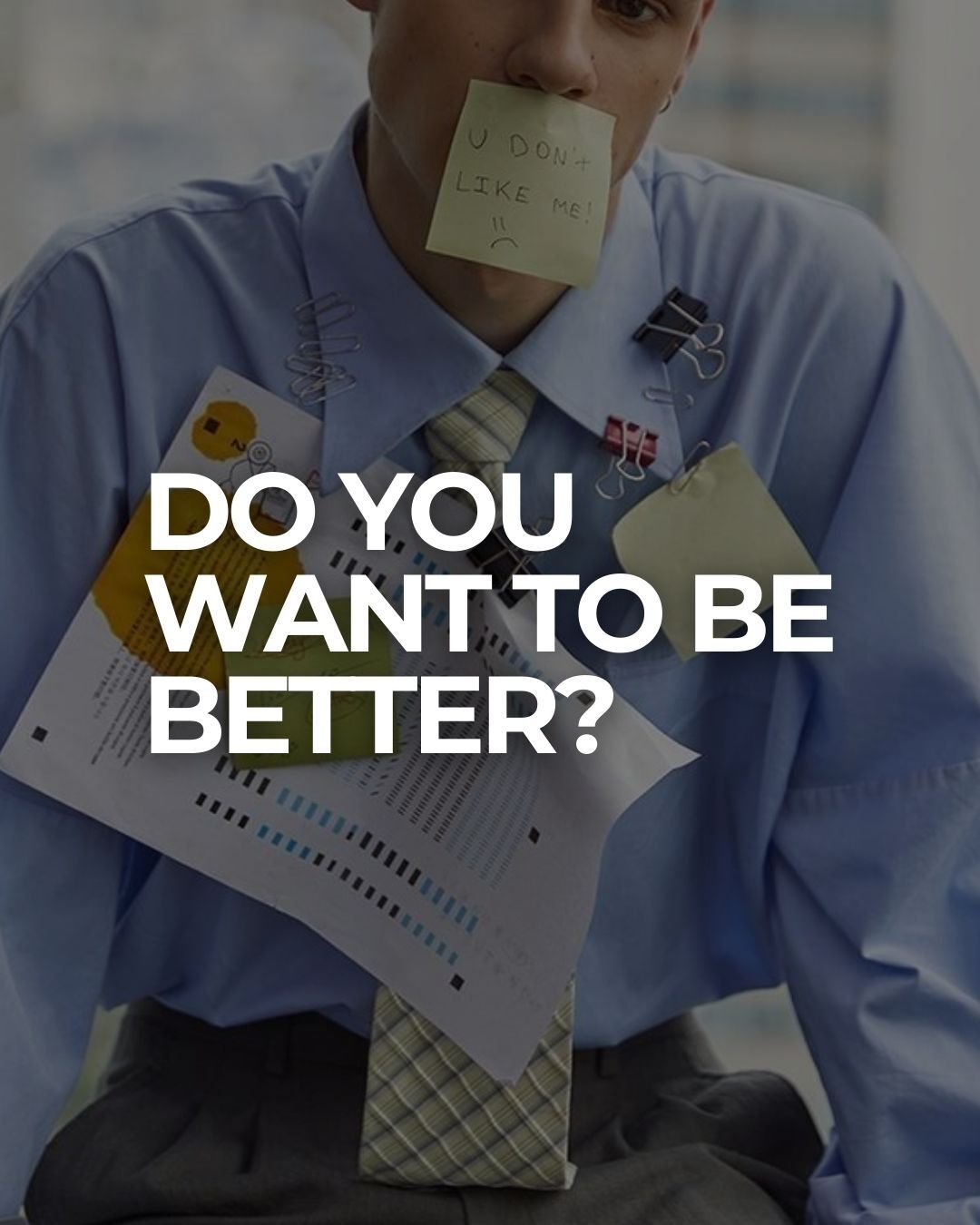
“Be better."
Jan 26, 2026
·
Hannah Feminella
“Be better.”
Two tiny words, that come with a lot of baggage and somehow land as both a pep talk and a personal attack.
For some of us, “be better” taps into our inner overachiever. The one who loves a gold star, a chart, a transformation. The part of us that gets high off progress, discipline, and the fantasy that one more improvement will finally make life click. To that version of you, “be better” feels like possibility. A challenge. A cosmic dare.
But for others, “be better” hits a sledgehammer. It reminds you of every time your effort wasn’t enough for someone. Every time you were compared, corrected, or told you were almost there, but not quite. It activates the part of you that already thinks you’re behind, messy, unfixable, failing at adulthood. To that version of you, “be better” sounds like: “You’re not good enough as you are.”
“Be better” can be a call to evolve. It can also be a weapon. It all depends on what voice you hear it in. Because if you hear “be better” in the voice of someone who loved you conditionally, it’ll feel like a threat. A reminder that safety requires performance. That your worth is earned, not inherent.
But if you hear “be better” in your own voice, or the one that loves you, roots for you, and actually knows your capacity, it hits completely differently. Suddenly it’s not criticism; it’s clarity. It’s not punishment; it’s permission. It’s you saying: “I know what I’m capable of. And I’m tired of pretending I don’t.”
Here’s the other twist: sometimes “be better” offends you because it’s true. Because you could be better, at boundaries, at honesty, at showing up on time, but you don’t want to deal with the discomfort that “better” requires. Improvement demands confrontation. Accountability. The death of a few old habits you’ve grown emotionally attached to.
And sometimes? “Be better” feels offensive because you’re actually doing everything you can, and someone is judging the season you’re in as if it’s a permanent flaw. You’re not lazy, you’re tired. You’re not unambitious, you’re depleted. You’re not avoiding growth, you’re avoiding collapse. In that case, “be better” is as tone-deaf as telling a marathon runner to “run faster” at mile 26.
A nuance we rarely give ourselves credit for: you can be proud of who you are and want to grow. You can want better without believing you’re broken. You can evolve from love, not shame.
So maybe the question isn’t, “Does ‘be better’ motivate you or offend you?” Maybe it’s: Who is saying it? Because the source matters as much as the statement. And “Who do you think you need to be better for?” A boss? A parent? An ex? An imaginary audience on the internet? Or yourself? Because I think the real answer lies there.
If you’re anything like me, “Be better” is a double edged sword. A duality. And that’s kind of the point. If “be better” never stings, it’s not touching anything real. Growth comes with a built-in ego bruise. To even consider being better, you have to admit you’re not at your fullest yet, not because you’re failing, but because you’re still in progress. To me, that’s not an insult. That’s an invitation.
The real shift is in how you translate it. “Be better” does not have to mean, you’re not enough. It can mean, you’re not done. It doesn’t have to read as, fix yourself. It can read as, expand yourself. If those words are coming from someone who profits off your insecurity, or from the part of you that only feels worthy when you’re improving, yeah, you get to mute that. You’re allowed to lay that version of “be better” to rest.
But if it’s coming from the part of you that’s tired of your own excuses, the part that knows you’re playing small, the part that wants a life that actually fits? Then let it land. Let it offend you a little. Let it poke the places you’ve gone numb. Not because you’re unworthy as you are, but because you’re finally ready to see what else you could be, without turning your whole existence into a punishment disguised as self-improvement.
“Be better” isn’t the enemy. It’s just a mirror. What you do with what you see? That part is entirely up to you. Until next time x